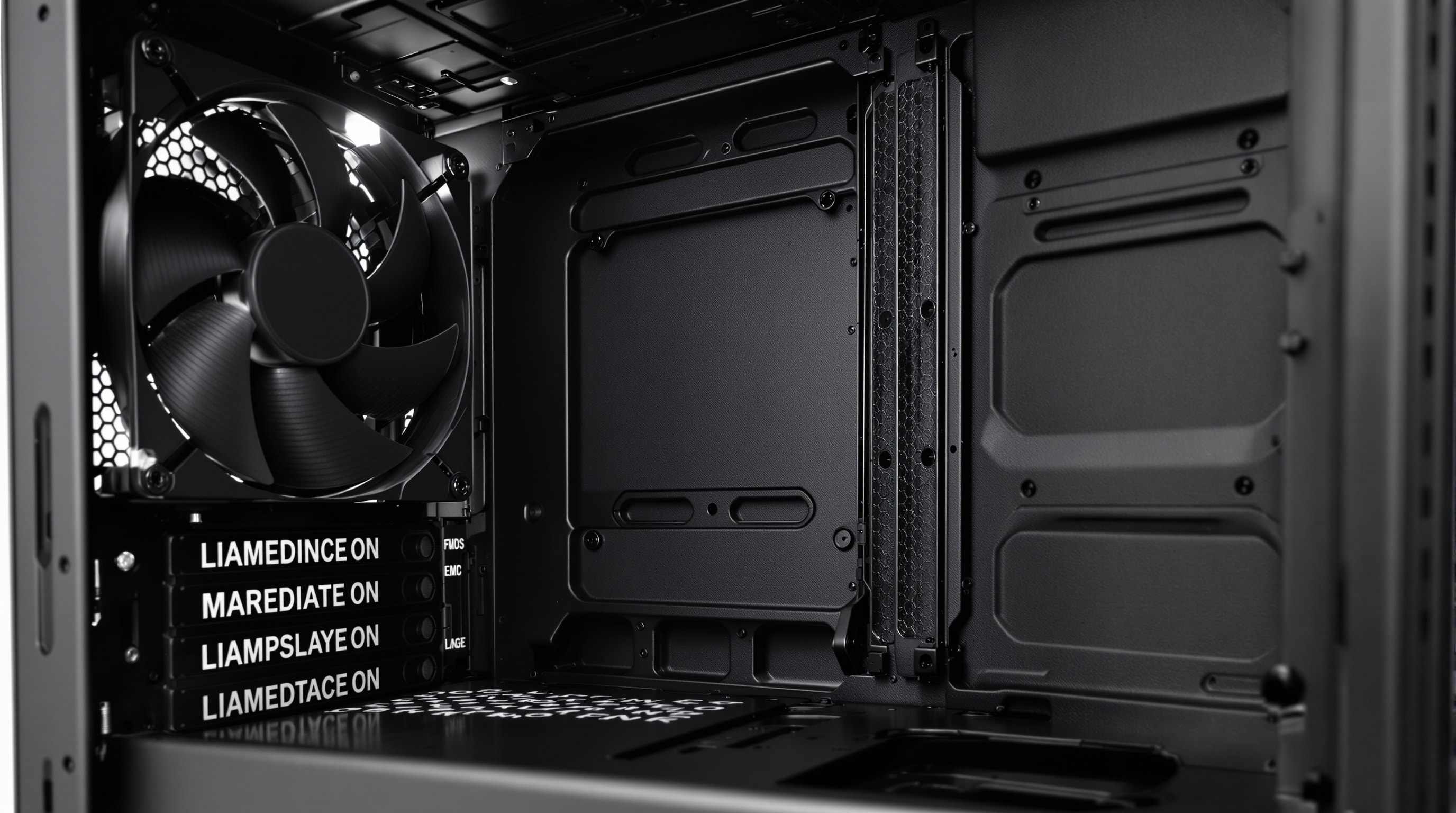
The case is the one component every other part lives inside, and it quietly sets the ceiling on how good your results can be. Choose well and a modest set of parts stays hushed; choose badly and even premium coolers and fans fight a losing battle against a chassis that whistles, rattles and rings.
Airflow versus damping: pick your emphasis
Quiet cases lean one of two ways. Airflow-first designs use open mesh fronts and large fan mounts to move a lot of air gently, keeping components cool so their fans stay slow. Damping-first designs enclose the chassis in solid panels lined with acoustic material to block whatever noise the components make. The best modern cases blend the two, but the tension is real: sound-blocking panels can trap heat, which forces fans faster, which makes more noise. A well-designed case resolves this with big, slow intakes and a clear front-to-back air path, so it never has to choose between hot and loud.
Steel or aluminium?
Material changes the character of a build. Aluminium is light and sheds heat well, which can help a passive or low-airflow system. Steel is heavier and, precisely because of that mass, is better at muffling noise and resisting the vibration that turns a panel into a soundboard. For a quiet build, a heavier steel chassis — or a case with thick, well-braced panels — usually has the edge, because mass is one of the simplest ways to stop sound getting out.
What makes a case quiet
- Room for large fans — 140mm or 120mm mounts let you move air slowly. This is the most important feature.
- A clear air path — cool air in the front, warm air out the back and top, with nothing whistling through small gaps.
- Rigid, well-braced panels — thin flexing steel drums and buzzes; solid panels stay quiet.
- Soft-mounted fans and drives — rubber grommets and isolated drive bays stop vibration reaching the shell.
- Cable routing — channels and tie points keep cables out of the airflow so fans work efficiently and quietly.
Damping done right
Many quiet cases line their panels with acoustic matting. This works by damping — converting panel vibration and some airborne sound into a tiny amount of heat — and by adding mass that resists ringing. It is genuinely effective on the flat side panels, which are the largest radiating surfaces. It does little, though, over open vents, and it cannot fix a case whose fans are simply too small and fast. Treat damping as the finishing touch on a fundamentally sound airflow design, not a rescue for a bad one. The soundproofing guide covers materials in detail.
Air pressure and dust
How you balance intake and exhaust fans shapes both noise and long-term quiet. A slight positive pressure — a little more air drawn in than pushed out — means fresh air enters through the filtered intakes rather than being sucked in through every unfiltered gap, which keeps dust out of the case. That matters for noise because dust is a slow saboteur: it clogs heatsink fins and coats fan blades, forcing everything to spin faster and rattle more over the months. Filtered intakes, a mild positive pressure, and an occasional clean keep a quiet build quiet for years rather than weeks — a small piece of planning that pays back long after the machine is assembled.
Small cases and home-theatre builds
Compact and living-room systems raise the difficulty: less room means smaller fans and tighter airflow, and a home-theatre PC has to be quiet enough to disappear during quiet scenes. Here, low-power efficient parts, a fanless or semi-passive supply, and generously sized intakes for the space matter even more. The classic noise-control order — reduce at source, then isolate, then enclose — is the right way to think about every case, large or small.