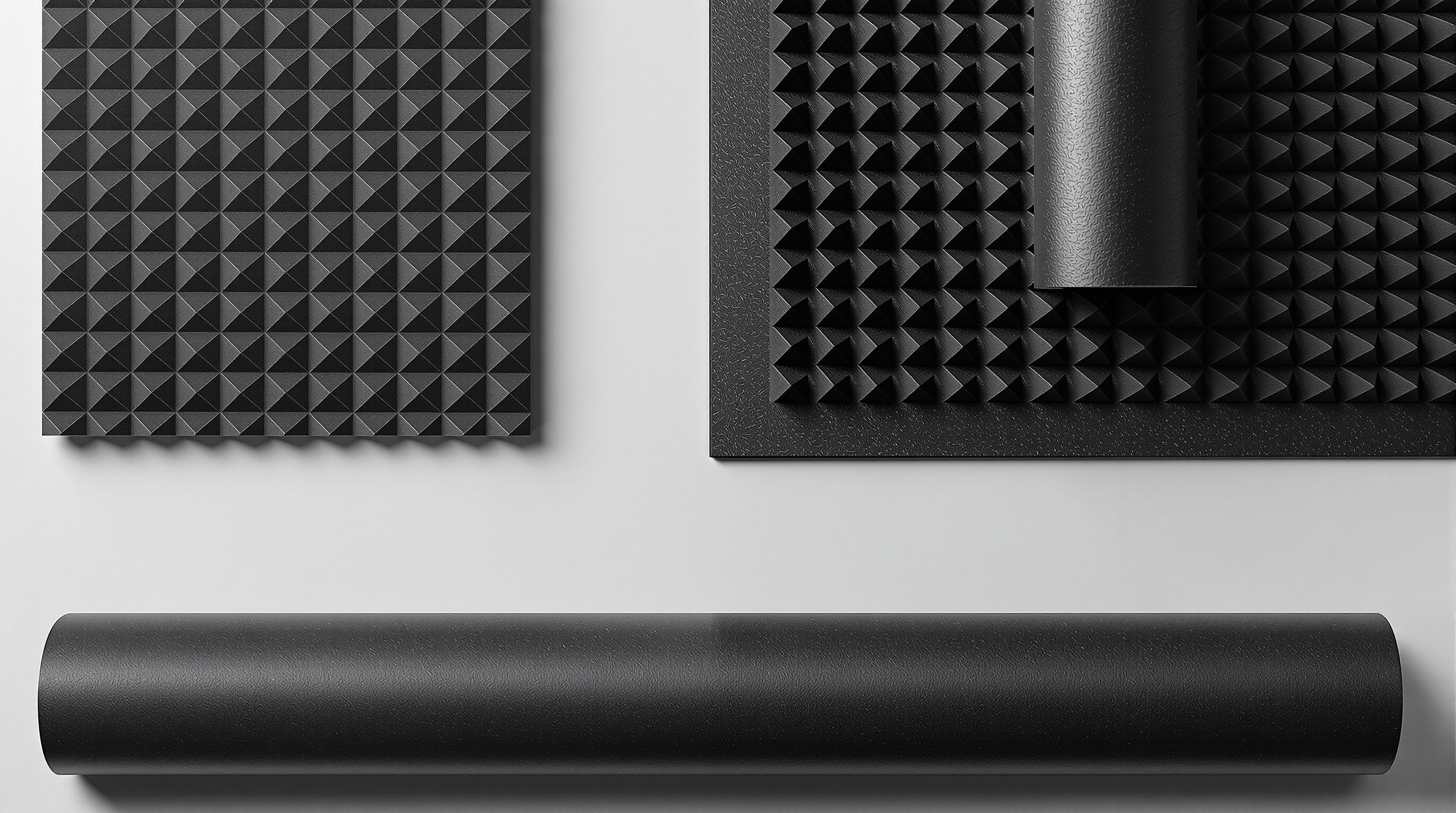
Soundproofing is the last layer of a quiet build, not the first. Once the fans are large and slow and the vibration is under control, damping materials help contain the low, broadband noise that is left. Applied thoughtfully they make a measurable difference; applied as a substitute for good cooling they simply add weight and trap heat.
The three tools: absorption, mass and damping
Acoustic treatment works in three distinct ways, and it helps to keep them separate. Absorption — open-cell foam — soaks up higher-frequency sound bouncing inside the case. Mass — a heavy, limp layer — blocks airborne sound from passing through a panel; the heavier and more flexible, the better. Damping — a constrained visco-elastic sheet — stops thin metal panels from resonating and ringing. Most computer “soundproofing” kits combine a mass-loaded or bitumen-style damping layer with a foam facing to do all three at once.
Where damping actually helps
The biggest, flattest surfaces radiate the most sound, so that is where treatment earns its keep. In practice:
- Side panels — the largest radiating surfaces; damping sheet here has the clearest effect.
- The base and roof — broad flat panels that benefit from a mass layer.
- Drive cages and blanking plates — small parts that buzz; a little damping stops the rattle.
Leave a margin around any vent or fan opening: covering airflow paths to chase a decibel of noise usually costs you several degrees of cooling, which the fans then have to claw back — noisily.
Where it does not help
Damping cannot quiet a fundamentally noisy machine. If a small fan is screaming or a pump is droning, foam on the panels only muffles the edges of the problem while trapping the heat that caused it. Sound also escapes readily through any open vent, so a heavily damped case with an open mesh front will leak most of its noise straight out the front. Fix the source first — the fans, the cooler, the vibration — and let damping do the modest, useful job it is actually good at.
A sensible application order
- Confirm the cooling is already quiet: large slow fans and an over-sized cooler.
- Decouple vibration with soft mounts — cheap and often the single biggest gain.
- Add a damping layer to the flat side panels, base and roof, keeping clear of vents.
- Only then consider a foam facing to absorb internal high-frequency reflections.
Common soundproofing mistakes
A few errors turn well-meant treatment into wasted effort. The first is covering vents and fan openings, which chokes airflow and forces fans faster — adding more noise than any foam removes. The second is treating damping as a cure for a loud fan or pump; it can only soften noise that is already reasonable, never rescue a screaming one. The third is piling on cheap open-cell foam and expecting it to block sound: foam absorbs higher frequencies bouncing inside the case, but it does little to stop airborne noise escaping — that job needs mass. Applied to the right surfaces in the right order, damping is genuinely effective; applied blindly, it mostly just adds weight and traps heat.
Materials in brief
You will meet a handful of material types: thin self-adhesive bitumen-style sheets that add damping mass to panels; heavier mass-loaded matting, sometimes with a foil facing, for serious airborne blocking; and open-cell acoustic foam for absorption. Kits often layer them together. None of it is exotic, and the principle is the same one that quietens rooms and cars: reduce the noise you can, then absorb and block the rest. Combined with a solid case, good damping turns a “quiet” PC into a “silent” one.